You're all caught up—no notifications available.
Explore All Exams at KGS


All Exams
Explore All Exams at KGS

Khan Sir Courses
Geography I Polity I History | World Map I Indian Map I Economics I Biology

UPSC & State PSC
UPSC I BPSC I UP-PSC I MP-PSC

State Exams
UP I Bihar I MP | Rajasthan

NEET | JEE | CUET | Boards
NEET | JEE | CUET | Boards

Defence Exams
NDA I CDS I CAPF I AFCAT I SSB I Agniveer

Police Exams
UP SI | Bihar SI | Delhi Police | UP Constable

SSC Exams
CGL I CPO I CHSL I MTS I SSC GD I Delhi Police

Foundation Courses
Physics I Chemistry I Biology I History I Geography I Polity I NCERT I Math I English | Map I Reasoning

Railway Exams
RRB | RPF

Teaching Exams
TET | Teaching | UGC

Banking Exams
SBI | RBI | IBPS

Engineering Exams
Civil | Electrical | Mechanical
UGC NET
UGC NET/JRF
Current Affairs provides you with the best compilation of the Daily Current Affairs taking place across the globe: National, International, Sports, Science and Technology, Banking, Economy, Agreement, Appointments, Ranks, and Report and General Studies

SYLLABUS
GS-2: Government policies and interventions for development in various sectors and issues arising out of their design and implementation.
GS-3: Science and Technology- developments and their applications and effects in everyday life.
Context: Annual organ transplants have increased nearly fourfold over the past decade, from fewer than 5,000 in 2013 to nearly 20,000 in 2025, according to the Ministry of Health and Family Welfare (MoHFW).
More on the News
• The transformation has been led by the National Organ and Tissue Transplant Organization (NOTTO), strengthened as the national coordinating authority for organ allocation and sharing.
• Public awareness has played a major role, with repeated appeals by Prime Minister Narendra Modi in his Mann Ki Baat programme helping normalize organ donation as a social responsibility.
• The Ministry describes the change as a shift toward a more ethical, transparent, and technology-enabled transplant ecosystem.
About the Organ Donation and Transplantation
• Organ donation and transplantation are the processes of removing a healthy organ from a donor and transplanting it into a person with organ failure.
• It involves two surgeries — one to retrieve the organ and another to transplant it into the recipient.
• The procedure offers a second chance at life for people with life-threatening organ diseases, though demand far exceeds supply globally.
• Types of Organ Donation:
Status of Organ Transplantation
• The number of organ transplants has risen from under 5,000 in 2013 to nearly 20,000 in 2025, marking a significant growth observed in transplant capacity.
• Around 18% of transplants now involve organs from deceased donors, indicating steady growth in cadaveric donation rates.
• In 2025 alone, over 1,200 families consented to organ donation after death, enabling multi-organ retrieval and saving thousands of lives.
• Since September 17, 2023, more than 4.8 lakh citizens have registered as organ donors through an Aadhaar-based digital verification system.
• India has developed strong capabilities in complex transplants such as heart, lung, and pancreas procedures, with outcomes comparable to global benchmarks at significantly lower costs.
• India ranks third globally in the total number of organ transplants, behind only the United States of America and China.
Legal Framework and Initiatives for Organ Donation in India
• The Transplantation of Human Organs and Tissues Act (THOTA), 1994 is India’s primary legislation regulating organ transplantation.
• The Transplantation of Human Organs (Amendment) Act, 2011 expanded the 1994 law by including tissues (such as skin, bone, cornea, and heart valves) along with organs, enabling a wider scope for transplantation.
• The Government of India has proposed a “One Nation, One Policy” for Organ Donation and Transplantation and initiated consultations with states. Key reforms include:
• Awareness and outreach initiatives include:
About the National Organ and Tissue Transplant Organisation
• NOTTO is the apex national body for organ and tissue donation and transplantation in India, established under the Transplantation of Human Organs and Tissues (Amendment) Act, 2011, and functioning under the Ministry of Health and Family Welfare.
• It coordinates nationwide procurement, allocation, distribution, registry, policy guidelines, training, and awareness activities, and also acts as the nodal agency for Delhi and NCR.
• NOTTO has two divisions: the National Organ and Tissue Removal and Storage Network and the National Biomaterial Centre (National Tissue Bank).
• The Regional Organ and Tissue Transplant Organisation are regional-level government organisations that act as an intermediate coordinating body between NOTTO and state agencies.
• The State Organ and Tissue Transplant Organisation are state-level nodal agency responsible for coordinating organ donation and transplantation within individual states.
Sources:
PIB
NOTTO
DD India
Organindia
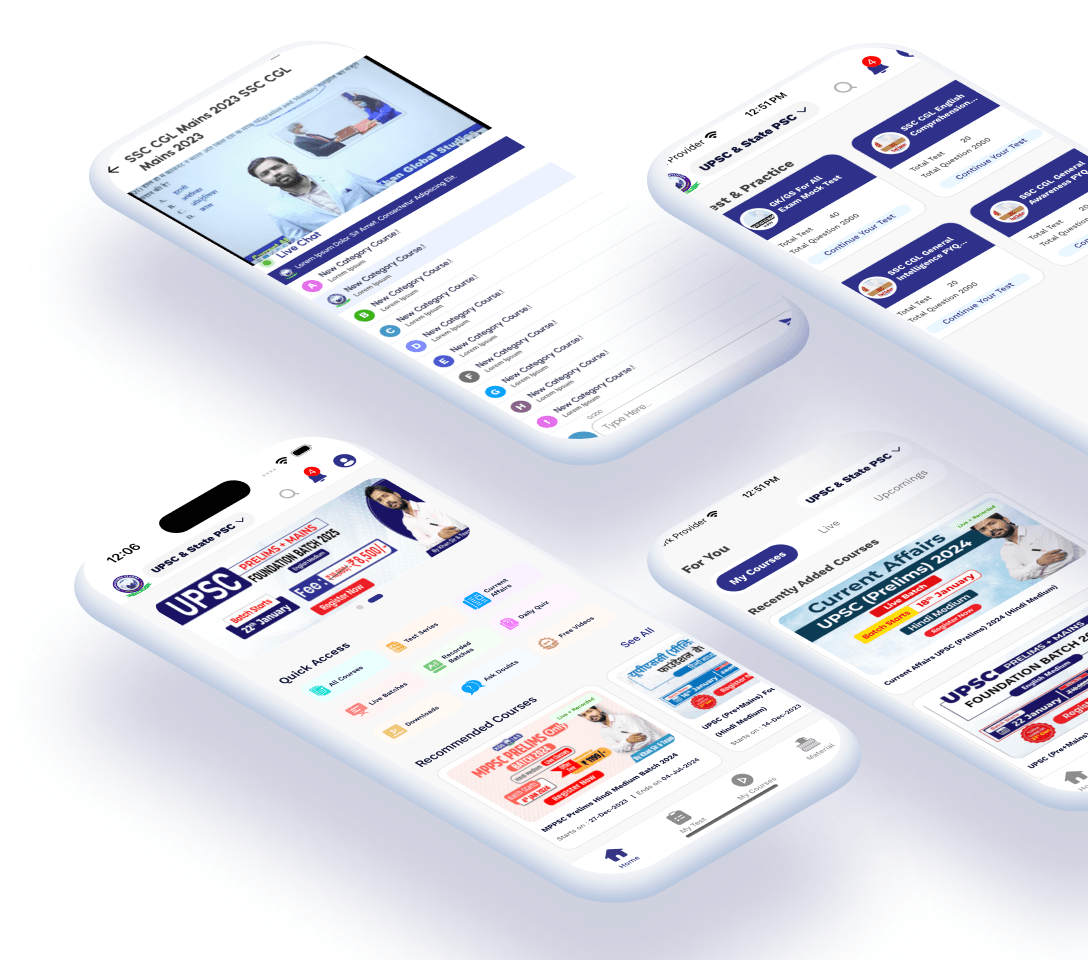
The most trusted learning platform on your phone
With our training programs, learning online can be a very exciting experience! Take the next step toward achieving your professional and personal objectives



Course Related Query:
Ask Your DoubtsStore Related Query:store@khanglobalstudies.comNCERT Books
Resources
We love learning. Through our innovative solutions, we encourage ourselves, our teams, and our Students to grow. We welcome and look for diverse perspectives and opinions because they enhance our decisions. We strive to understand the big picture and how we contribute to the company’s objectives. We approach challenges with optimism and harness the power of teamwork to accomplish our goals. These aren’t just pretty words to post on the office wall. This is who we are. It’s how we work. And it’s how we approach every interaction with each other and our Students.
Come with an open mind, hungry to learn, and you’ll experience unmatched personal and professional growth, a world of different backgrounds and perspectives, and the freedom to be you—every day. We strive to build and sustain diverse teams and foster a culture of belonging. Creating an inclusive environment where every students feels welcome, appreciated, and heard gives us something to feel (really) good about.
Get Free academic Counseling & Course Details