You're all caught up—no notifications available.
Explore All Exams at KGS


All Exams
Explore All Exams at KGS

Khan Sir Courses
Geography I Polity I History | World Map I Indian Map I Economics I Biology

UPSC & State PSC
UPSC I BPSC I UP-PSC I MP-PSC

State Exams
UP I Bihar I MP | Rajasthan

NEET | JEE | CUET
NEET | JEE | CUET

Defence Exams
NDA I CDS I CAPF I AFCAT I SSB I Agniveer

Police Exams
UP SI | Bihar SI | Delhi Police | UP Constable

SSC Exams
CGL I CPO I CHSL I MTS I SSC GD I Delhi Police

Foundation Courses
Physics I Chemistry I Biology I History I Geography I Polity I NCERT I Math I English | Map I Reasoning

Railway Exams
RRB | RPF

Teaching Exams
TET | Teaching | UGC

Banking Exams
SBI | RBI | IBPS

Engineering Exams
Civil | Electrical | Mechanical
UGC NET
UGC NET/JRF
Current Affairs provides you with the best compilation of the Daily Current Affairs taking place across the globe: National, International, Sports, Science and Technology, Banking, Economy, Agreement, Appointments, Ranks, and Report and General Studies

SYLLABUS
GS-2: Issues Relating to Development and Management of Social Sector/Services relating to Health, Education, Human Resources; Government Policies and Interventions for Development in various sectors and Issues arising out of their Design and Implementation.
Context: The Supreme Court has stayed the University Grants Commission’s (UGC) new equity rules, stating that the rules were prima facie vague and have the potential to divide society.
More on the News
• The UGC (Promotion of Equity in Higher Education Institutions) Regulations, 2026, were introduced by the government to supersede the UGC Regulations, 2012 with the stated objective of fostering equity, inclusion and a discrimination-free academic environment across higher education institutions in line with the National Education Policy, 2020.
• Using the powers under Article 142, the Supreme Court, while putting the 2026 Regulations in abeyance for the time being, directed that the UGC Regulations, 2012, would continue to be in force.
• The petitioners have primarily challenged Section 3(1)(c) of the 2026 Regulations, saying it refers to discrimination only on the basis of caste or tribe against the members of SC, ST and OBC communities while excluding those from the general category.
Need for New Regulations
• According to the UGC, complaints related to caste-based discrimination have increased by over 118% in five years, from 173 cases in 2019–20 to 378 in 2023–24.
• During 2019–20 to 2023–24, a total of 1,160 complaints were received from 704 universities and 1,553 colleges nationwide.
Key Provisions of the Regulations
• Definition of Caste-Based Discrimination: Defined discrimination specifically against members of the Scheduled Castes (SCs), Scheduled Tribes (STs), and Other Backwards Classes (OBCs) communities.
• Broaden the Definition of Discrimination: Discrimination has defined on broader grounds such as unfair, biased or differential treatment whether explicit or implicit, as caste, religion, race, gender, place of birth, or disability, including acts that impair equality in education or violate human dignity.
• Mandatory Equity Committees: Every higher education institution (HEI) must constitute an Equity Committee, which must include members from OBC, SC, ST, persons with disabilities (PwDs), and women.
• Equal Opportunity Centres (EOCs): Each Higher education institution (HEI) must also set up an Equal Opportunity Centre, which will be operated by the equity committee.
• Mandatory Compliance: For the first time, the Regulations prescribe stringent penalties for non-compliance, including debarment from UGC funding, prohibition on launching new programmes, and derecognition as a UGC-approved institution.
• Grievance Redressal Mechanism:
Issues and Challenges in the Regulations
• Unequal Protection and Exclusion: By restricting “caste-based discrimination” to SC, ST, and OBC categories, the Regulations risk excluding students from the unreserved category who may also experience discrimination, raising concerns of unequal protection.
• Removal of the False Complaint Penalty: The absence of explicit safeguards or penalties against malicious or false complaints has raised concerns about potential misuse and the creation of a climate of fear within academic institutions.
• Constitutional Violation: Petitioners contend that the Regulations institutionalise a hierarchy of protection and lack adequate procedural safeguards, thereby potentially violating the Right to Equality under Articles 14 and 15 of the Constitution.
• Inadequate Capacity: Experts point out that while the rules are strict on paper, many HEIs lack the administrative and financial capacity to run 24/7 helplines, independent inquiries, and continuous compliance monitoring.

Two More Wetlands Get Ramsar Tag
Right to Menstrual Health a Fundamental Right
Amendments to New Drugs and Clinical Trials (NDCT) Rules, 2019
Supreme Court Stays UGC's New Equity Regulations
India’s infrastructure spend tops 3% of GDP as climate risks strain insurance cover: Report
SystemIndia’s Multi-Hazard Early Warning Decision Support System
India–Australia Economic Cooperation and Trade Agreement (Ind-Aus ECTA)
Defence Exports Touched an All-Time High in Financial Year 2025-26
Government Notifies Conditional Concessional Customs Duty for SEZ
Artemis II Mission
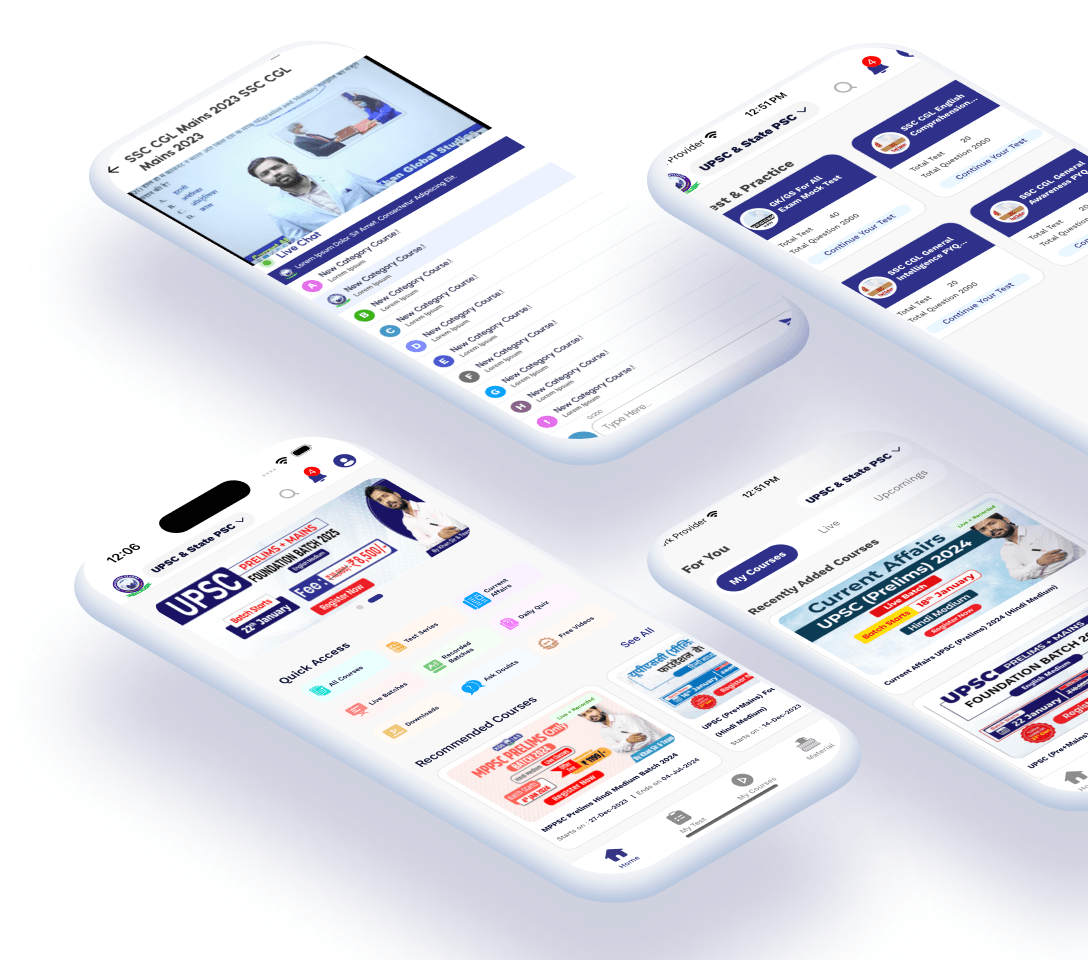
The most trusted learning platform on your phone
With our training programs, learning online can be a very exciting experience! Take the next step toward achieving your professional and personal objectives



Course Related Query:
Ask Your DoubtsStore Related Query:store@khanglobalstudies.comNCERT Books
Resources
We love learning. Through our innovative solutions, we encourage ourselves, our teams, and our Students to grow. We welcome and look for diverse perspectives and opinions because they enhance our decisions. We strive to understand the big picture and how we contribute to the company’s objectives. We approach challenges with optimism and harness the power of teamwork to accomplish our goals. These aren’t just pretty words to post on the office wall. This is who we are. It’s how we work. And it’s how we approach every interaction with each other and our Students.
Come with an open mind, hungry to learn, and you’ll experience unmatched personal and professional growth, a world of different backgrounds and perspectives, and the freedom to be you—every day. We strive to build and sustain diverse teams and foster a culture of belonging. Creating an inclusive environment where every students feels welcome, appreciated, and heard gives us something to feel (really) good about.
Get Free academic Counseling & Course Details