You're all caught up—no notifications available.
Explore All Exams at KGS


All Exams
Explore All Exams at KGS

Khan Sir Courses
Geography I Polity I History | World Map I Indian Map I Economics I Biology

UPSC & State PSC
UPSC I BPSC I UP-PSC I MP-PSC

State Exams
UP I Bihar I MP | Rajasthan

NEET | JEE | CUET
NEET | JEE | CUET

Defence Exams
NDA I CDS I CAPF I AFCAT I SSB I Agniveer

Police Exams
UP SI | Bihar SI | Delhi Police | UP Constable

SSC Exams
CGL I CPO I CHSL I MTS I SSC GD I Delhi Police

Foundation Courses
Physics I Chemistry I Biology I History I Geography I Polity I NCERT I Math I English | Map I Reasoning

Railway Exams
RRB | RPF

Teaching Exams
TET | Teaching | UGC

Banking Exams
SBI | RBI | IBPS

Engineering Exams
Civil | Electrical | Mechanical
UGC NET
UGC NET/JRF
Current Affairs provides you with the best compilation of the Daily Current Affairs taking place across the globe: National, International, Sports, Science and Technology, Banking, Economy, Agreement, Appointments, Ranks, and Report and General Studies

SYLLABUS
GS-2: Bilateral, Regional and Global Groupings and Agreements involving India and/or affecting India’s interests.
GS-3: Indian Economy and issues relating to Planning, Mobilization of Resources, Growth, Development and Employment.
Context: The European Union (EU) has suspended export benefits to sectors such as textiles and plastics under a preferential scheme for India and two other countries from January 1, a move that will impact the country's shipment to the 27-nation bloc.
More on the news
• According to the Official Journal of the European Union, the European Commission on September 25, 2025, laid down rules for the application of the regulation with regard to the suspension for 2026-2028 of certain tariff preferences granted to certain GSP beneficiary countries - India, Indonesia, and Kenya.
• The development is important as India and the EU are likely to announce the closure of negotiations for a free trade agreement (FTA) on January 27.
• The Indian Commerce Ministry has stated that the revised GSP rules will only affect about 2.7% of India’s exports to the EU.
Key highlights of the Development
• Key Sectors Covered: The EU has removed GSP benefits across almost all major industrial sectors - minerals, chemicals, plastics and rubber, textiles and garments, stone and ceramics, precious metals, iron and steel, base metals, machinery, electrical goods and transport equipment - which together form the backbone of India's exports to Europe.
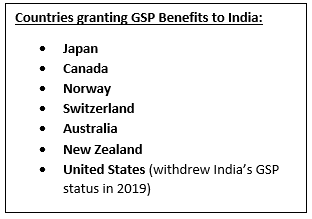
• Previous Graduation
• Legal Justification: The EU's move follows its GSP graduation rules, under which preferences are withdrawn once exports in a product group cross a threshold for three consecutive years.
Impact of GSP suspension on India
• High trade barriers in the near term: loss of GSP preferences coincides with the start of the tax phase of the EU's Carbon Border Adjustment Mechanism (CBAM).
• Impact on exports: Think tank Global Trade Research Initiative (GTRI) said from January 1, 2026, India faces a "major setback" in the EU market, as 87% of its exports begin paying higher import tariffs.
• Setback for Apparel exporters: Pay full 12% duty instead of 9.6% under the GSP, reducing India's competitiveness and pushing EU buyers toward duty-free suppliers like Bangladesh and Vietnam.
About Generalised Scheme of Preferences (GSP):
• The EU's GSP is a unilateral trade arrangement that allows developing countries to export to the EU at lower-than-MFN tariffs.
• WTO compliant: The GSP is non-reciprocal and operates as an exception to the WTO’s Most-Favoured-Nation (MFN) principle.
• Different Types: The European Union offers different trade benefits under the GSP scheme.
• Graduation Clause: Countries are grouped by income and export competitiveness, and benefits are withdrawn through 'graduation' once exports in a product group become large over time.

Eu Suspends GSP Export Benefits For India's Shipments
White Paper on Strengthening AI Governance Through Techno-Legal Framework
Padma Awards 2026
Military Quantum Mission Policy Framework
SystemIndia’s Multi-Hazard Early Warning Decision Support System
India–Australia Economic Cooperation and Trade Agreement (Ind-Aus ECTA)
Defence Exports Touched an All-Time High in Financial Year 2025-26
Government Notifies Conditional Concessional Customs Duty for SEZ
Artemis II Mission
The most trusted learning platform on your phone
With our training programs, learning online can be a very exciting experience! Take the next step toward achieving your professional and personal objectives



Course Related Query:
Ask Your DoubtsStore Related Query:store@khanglobalstudies.comNCERT Books
Resources
We love learning. Through our innovative solutions, we encourage ourselves, our teams, and our Students to grow. We welcome and look for diverse perspectives and opinions because they enhance our decisions. We strive to understand the big picture and how we contribute to the company’s objectives. We approach challenges with optimism and harness the power of teamwork to accomplish our goals. These aren’t just pretty words to post on the office wall. This is who we are. It’s how we work. And it’s how we approach every interaction with each other and our Students.
Come with an open mind, hungry to learn, and you’ll experience unmatched personal and professional growth, a world of different backgrounds and perspectives, and the freedom to be you—every day. We strive to build and sustain diverse teams and foster a culture of belonging. Creating an inclusive environment where every students feels welcome, appreciated, and heard gives us something to feel (really) good about.
Get Free academic Counseling & Course Details