logo

All Exams

Notifications

All Exams

Explore All Exams at KGS

All Exams
Home>Current Affairs>First Release of Consumer Price Index on New Base Year
Current Affairs made simple.

Current Affairs provides you with the best compilation of the Daily Current Affairs taking place across the globe: National, International, Sports, Science and Technology, Banking, Economy, Agreement, Appointments, Ranks, and Report and General Studies

banner-image

First Release of Consumer Price Index on New Base Year

SYLLABUS

GS-3: Indian Economy and issues relating to planning, mobilization of resources, growth, development and employment.

Context: Recently, the Ministry of Statistics and Programme Implementation (MoSPI) released CPI data with a base year of 2024.

More on the News

  • January 2026 retail inflation stood at 2.75%, marking the first inflation reading under the revised methodology.
  • The new series replaces the CPI with base year 2012 and reflects structural shifts in the Indian economy, such as urbanisation, digitalisation, and changing consumption patterns.
  • Inflation Highlights:
  • Headline CPI inflation: 2.75%
  • Rural inflation: 2.73%
  • Urban inflation: 2.77%
  • Food inflation: ~2.13%
  • Housing inflation: ~2.05%
  • Inflation remained within the RBI’s 2–6% target band.
  • Tomato prices rose sharply, while onion, potato, and garlic prices declined significantly. Jewellery inflation remained elevated, especially for silver.

What is CPI, and Why is the Base Year Revised?

  • The CPI measures changes in prices of goods and services consumed by households and serves as a key indicator of cost-of-living inflation.
  • The CPI is the Reserve Bank of India’s primary inflation gauge and plays a central role in monetary policy and interest rate decisions.
  • The base year is the reference point against which price changes are measured, with its index fixed at 100.
  • As household consumption patterns evolve, the base year is periodically updated to ensure the index remains representative.
  • The earlier CPI series (base 2012) had become outdated due to major structural shifts such as rising incomes, urbanization, digitalization, expansion of services, and changing consumption patterns.
  • The revision aligns with IMF recommendations of updating CPI baskets periodically.
  • The new series is based on the Household Consumption Expenditure Survey (HCES) 2023–24, ensuring alignment between consumption weights and current price structures.
  • MoSPI also aligned the weight reference period with the price reference period to minimise base-year bias.

Key Changes

  • Updated Base Year: The base year has been revised from 2012 to 2024.
  • The price reference period is January–December 2024, while weights are derived from HCES 2023–24.
  • Expanded Consumption Basket: The total number of items increased from 299 to 358, with goods rising to 308 and services to 50.
  • This reflects the growing importance of services in household consumption.
  • New additions include OTT subscriptions, digital storage devices, exercise equipment, babysitters, and rural housing rent.
  • Obsolete items such as VCRs, cassette players, and other outdated electronics have been removed.
  • Adoption of COICOP 2018: The new CPI adopts the UN’s COICOP 2018 classification framework.
  • This replaces six broad groups with a detailed hierarchy of 12 divisions, 43 groups, 92 classes, and 162 subclasses.
  • This improves global comparability and enables more granular inflation tracking. Minor adaptations were made to reflect Indian consumption patterns.
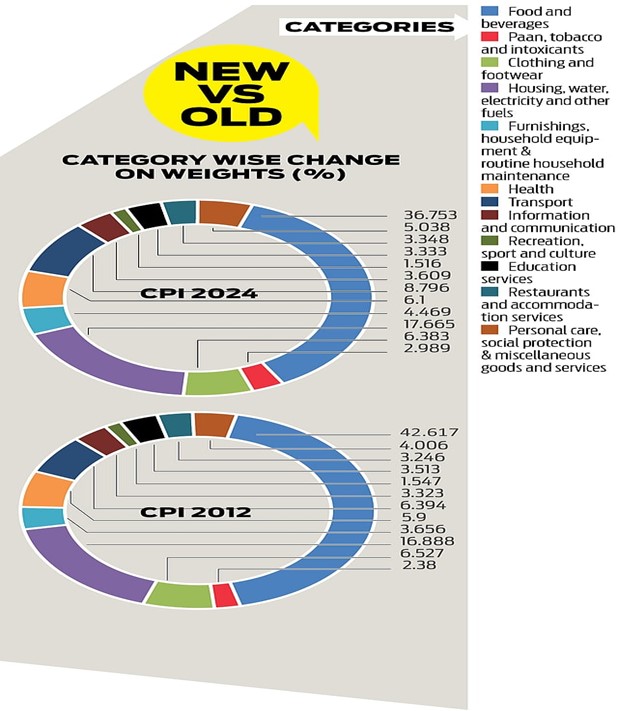
  • Revised Weights: Weights were updated using HCES 2023–24 data.
  • The food weight declined from about 9% to around 36.75%, reflecting rising incomes and diversification of consumption.
  • Housing weight increased to about 17.67%, while transport, health, and services also gained higher shares.
  • The reduced food weight is expected to lower inflation volatility.
  • Housing Index Revision: The housing index now includes rent, maintenance, and utilities.
  • Rural housing rent has been included for the first time, improving national representativeness.

Methodological Changes

  • Modernised Data Collection: Data collection has shifted to tablet-based Computer Assisted Personal Interviewing (CAPI). This enables real-time validation, geo-tagging of shops, and faster data processing.
  • Wider Market Coverage: Rural market coverage has expanded to 1,465 villages, while urban coverage exceeds 1,400 markets across over 430 towns.
  • Online markets have been added in 12 major cities to capture e-commerce price trends.
  • Alternative Data Sources: Administrative data is used for fuel prices, rail fares, and postal charges.
  • Online sources are used for airfares, telecom plans, and OTT subscriptions. This improves data accuracy and reduces field errors.
  • Improved Methodology: The Long Jevons method has been replaced by a chain-based price measurement approach.
  • This allows smoother handling of product replacements and quality changes.
  • Centralised pricing is used for regulated items, and free items are excluded as CPI measures prices actually paid by households.

SOURCES:
The Hindu
PIB
Indian Express
New Indian Express
Economic Time
footer image

The most trusted learning platform on your phone

With our training programs, learning online can be a very exciting experience! Take the next step toward achieving your professional and personal objectives


app-storeplay-store
logo
Khan Global Studies Pvt. Ltd. 5th Floor,
A13A, Graphix 1 Tower B, Sector 62,
Noida, Uttar Pradesh 201309

Course Related Query: enquiry@khanglobalstudies.com Store Related Query: store@khanglobalstudies.com

Get Free Academic Counseling & Course Details

KGS best learning platform

About Khan Global Studies

We love learning. Through our innovative solutions, we encourage ourselves, our teams, and our Students to grow. We welcome and look for diverse perspectives and opinions because they enhance our decisions. We strive to understand the big picture and how we contribute to the company’s objectives. We approach challenges with optimism and harness the power of teamwork to accomplish our goals. These aren’t just pretty words to post on the office wall. This is who we are. It’s how we work. And it’s how we approach every interaction with each other and our Students.


What Makes Us Different

Come with an open mind, hungry to learn, and you’ll experience unmatched personal and professional growth, a world of different backgrounds and perspectives, and the freedom to be you—every day. We strive to build and sustain diverse teams and foster a culture of belonging. Creating an inclusive environment where every students feels welcome, appreciated, and heard gives us something to feel (really) good about.

Copyright 2026 KhanGlobalStudies

Have a question?

Get Free academic Counseling & Course Details

floatButton
First Release of Consumer Price Index on New Base Year | Current Affairs