You're all caught up—no notifications available.
Explore All Exams at KGS


All Exams
Explore All Exams at KGS

Khan Sir Courses
Geography I Polity I History | World Map I Indian Map I Economics I Biology

UPSC & State PSC
UPSC I BPSC I UP-PSC I MP-PSC

State Exams
UP I Bihar I MP | Rajasthan

NEET | JEE | CUET | Boards
NEET | JEE | CUET | Boards

Defence Exams
NDA I CDS I CAPF I AFCAT I SSB I Agniveer

Police Exams
UP SI | Bihar SI | Delhi Police | UP Constable

SSC Exams
CGL I CPO I CHSL I MTS I SSC GD I Delhi Police

Foundation Courses
Physics I Chemistry I Biology I History I Geography I Polity I NCERT I Math I English | Map I Reasoning

Railway Exams
RRB | RPF

Teaching Exams
TET | Teaching | UGC

Banking Exams
SBI | RBI | IBPS

Engineering Exams
Civil | Electrical | Mechanical
UGC NET
UGC NET/JRF
Current Affairs provides you with the best compilation of the Daily Current Affairs taking place across the globe: National, International, Sports, Science and Technology, Banking, Economy, Agreement, Appointments, Ranks, and Report and General Studies

SYLLABUS
GS-3: Disaster and disaster management.
Context: India has released its first-ever Guidelines and Standard Operating Procedures (SOPs) for Disaster Victim Identification (DVI) through the National Disaster Management Authority (NDMA).
More on the News
• The guidelines aim to ensure systematic identification, registration, and dignified handover of human remains to families during mass fatality incidents.
• They were formulated in response to repeated cases where disaster victims remained unidentified or were extremely difficult to identify, leading to prolonged distress for families and delays in legal closure and compensation.
• The framework seeks to integrate multiple forensic disciplines under a unified command structure to address fragmentation and coordination failures observed during past disasters.
• The guidelines incorporate lessons from the Ahmedabad AI-171 plane crash, highlighting the critical importance of forensic odontology and DNA analysis, and stress the need for establishing a National Dental Data Registry.
• The approved DVI methods include forensic odontology, DNA analysis, forensic nursing, post-mortem fingerprinting, humanitarian forensics, virtual autopsy, and forensic archaeology.
About Disaster Victim Identification (DVI)
• Disaster Victim Identification (DVI) is a structured, multidisciplinary, medico-legal, and humanitarian process used to identify deceased persons following mass fatality incidents.
• It relies on scientifically validated identifiers and follows internationally accepted standards, particularly those laid down by Interpol.
National Dental Data Registry
• As per Interpol DVI Guidelines (2023), fingerprints, dental examination (forensic odontology), and DNA profiling are the three primary scientific identifiers, while tattoos, scars, and ornaments are considered secondary and less reliable.
• During the AI-171 plane crash in Ahmedabad, nearly 260 charred and commingled bodies could not be identified using conventional methods such as visual identification or fingerprinting.
• Authorities relied primarily on forensic odontology and DNA analysis in accordance with Interpol standards to establish identities.
• Drawing from this experience, the NDMA guidelines recommend creating a National Dental Data Registry to enable systematic comparison of ante-mortem and post-mortem dental data during future disasters.
Four Stages of the DVI Process
• The guidelines clearly define stakeholder roles and emphasise the need for a unified DVI command to manage the four stages of the identification process:
1. Scene Phase: Systematic recovery of human remains from the disaster site with proper documentation, tagging, mapping, and preservation.
2. Collection of Post-Mortem Data: Medico-legal examination and forensic documentation, including fingerprints, DNA sampling, dental examination, and virtual autopsy.
3. Collection of Ante-Mortem Data: Collection of personal, medical, dental records, photographs, and DNA samples from families and relevant authorities.
4. Reconciliation: Scientific comparison of ante-mortem and post-mortem data for confirmation of identity, certification of death, and dignified release of remains to families.
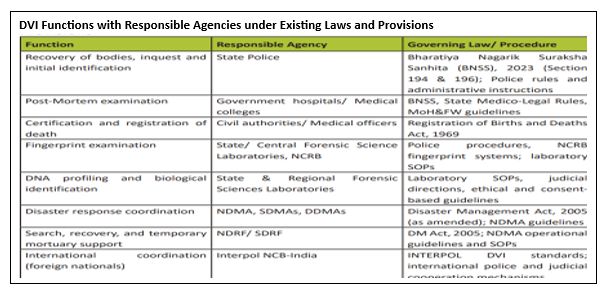
Recommended DVI Techniques
• The guidelines recommend the following DVI techniques based on the nature of the disaster:
Scientific Identification Standards
• The identification process must rely on scientific and verifiable standards, including:
o Biometrics
o Authentic documents
o Forensic identification methods compliant with Interpol norms
Key Challenges
• The guidelines acknowledge major operational and institutional challenges in India’s existing DVI framework:
o Absence of an operational DVI incident commander for inter-agency coordination.
o Lack of a standardised system for collecting ante-mortem data.
o Shortage of trained forensic experts and overburdened forensic laboratories.
o Inconsistent tagging, mapping, and chain-of-custody practices, increasing misidentification and legal risks.
o Complex death declaration procedures and absence of a multidisciplinary approach, delaying compensation and legal closure.
o Inadequate or delayed deployment of emergency responders, including forensic DVI stakeholders.
The most trusted learning platform on your phone
With our training programs, learning online can be a very exciting experience! Take the next step toward achieving your professional and personal objectives



NCERT Books
Resources
We love learning. Through our innovative solutions, we encourage ourselves, our teams, and our Students to grow. We welcome and look for diverse perspectives and opinions because they enhance our decisions. We strive to understand the big picture and how we contribute to the company’s objectives. We approach challenges with optimism and harness the power of teamwork to accomplish our goals. These aren’t just pretty words to post on the office wall. This is who we are. It’s how we work. And it’s how we approach every interaction with each other and our Students.
Come with an open mind, hungry to learn, and you’ll experience unmatched personal and professional growth, a world of different backgrounds and perspectives, and the freedom to be you—every day. We strive to build and sustain diverse teams and foster a culture of belonging. Creating an inclusive environment where every students feels welcome, appreciated, and heard gives us something to feel (really) good about.
Get Free academic Counseling & Course Details