You're all caught up—no notifications available.
Explore All Exams at KGS


All Exams
Explore All Exams at KGS

Khan Sir Courses
Geography I Polity I History | World Map I Indian Map I Economics I Biology

UPSC & State PSC
UPSC I BPSC I UP-PSC I MP-PSC

State Exams
UP I Bihar I MP | Rajasthan

NEET | JEE | CUET | Boards
NEET | JEE | CUET | Boards

Defence Exams
NDA I CDS I CAPF I AFCAT I SSB I Agniveer

Police Exams
UP SI | Bihar SI | Delhi Police | UP Constable

SSC Exams
CGL I CPO I CHSL I MTS I SSC GD I Delhi Police

Foundation Courses
Physics I Chemistry I Biology I History I Geography I Polity I NCERT I Math I English | Map I Reasoning

Railway Exams
RRB | RPF

Teaching Exams
TET | Teaching | UGC

Banking Exams
SBI | RBI | IBPS

Engineering Exams
Civil | Electrical | Mechanical
UGC NET
UGC NET/JRF
Current Affairs provides you with the best compilation of the Daily Current Affairs taking place across the globe: National, International, Sports, Science and Technology, Banking, Economy, Agreement, Appointments, Ranks, and Report and General Studies

SYLLABUS
GS 2: Important International institutions, agencies and fora- their structure, mandate
GS 3: Conservation, environmental pollution and degradation and Issues related to direct and indirect farm subsidies.
Context: Recently, UNEP (United Nations Environment Programme) released the State of Finance for Nature 2026 report, which highlights that global investment in nature remains far off track for effectively addressing climate change, biodiversity loss, and ecosystem degradation.
More on the news
• The report marks its fourth edition and is titled Nature in the Red: Powering the Trillion-Dollar Nature Transition Economy.
• This edition used more robust methods to track Nature-based solutions (NbS) finance flows in 2023, NbS investment needs and opportunities to 2030 and 2050, and nature-negative finance.
• This report also introduced the Nature Transition X-Curve, a practical framework for the transition to a nature-positive society.
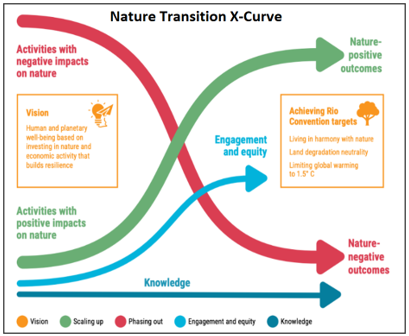
Key highlights of the Report:
• Imbalance in Environmental finance: The report finds that for every $1 invested globally in protecting nature, around $30 is spent on activities that harm it, underscoring the urgent need to realign financial flows.
• Nature-negative Spending: In the year 2023, global finance directly harmful to nature reached $7.3 trillion, while investment in NbS amounted to only $220 billion.
• Private Nature-negative finance: Of the $7.3 trillion spent on nature-negative activities in 2023, approximately $4.9 trillion came from private investment, largely concentrated in sectors such as utilities, industrials, energy, and basic materials.
• Public subsidies driving Nature-negative finance: Another $2.4 trillion flowed through environmentally harmful public subsidies, primarily supporting fossil fuels, agriculture, and water use.
• Decline in Private Oil and Gas Investment: Private investment in oil and gas activities harmful to nature dropped sharply, from nearly $1 trillion in 2020 to $519 billion in 2023.
• Finance into Nature-based solutions: Finance for NbS reached $220 billion in 2023, with public domestic expenditure emerging as the largest contributor at $190 billion, marking a 4% increase from 2022.
• Financing gap: According to UNEP, although finance for NbS has grown, it remains far below the levels needed to achieve the Rio Convention targets on biodiversity, climate action, and land restoration.
• Regional disparities: In 2023, government spending on NbS was highest in Asia at $93 billion, despite a 4% decline compared with 2022.
UNEP’s recommendations to minimise the nature finance gap:
• Reform in subsidies: Environmentally damaging subsidies and direct public spending need to be reformed to support the Rio Convention targets.
• Enhanced Government investment: Government investment for nature-based solutions, especially in areas that provide critical public goods should be increased.
• Strengthened Oversight: Effective regulation and incentives are needed to align investment decisions with the value of nature and ecosystem services.
• Mandate disclosure of nature-related risks: Organizations should be required to report nature-related risks and impacts, helping to shift financial incentives toward sustainable practices.

The most trusted learning platform on your phone
With our training programs, learning online can be a very exciting experience! Take the next step toward achieving your professional and personal objectives



NCERT Books
Resources
We love learning. Through our innovative solutions, we encourage ourselves, our teams, and our Students to grow. We welcome and look for diverse perspectives and opinions because they enhance our decisions. We strive to understand the big picture and how we contribute to the company’s objectives. We approach challenges with optimism and harness the power of teamwork to accomplish our goals. These aren’t just pretty words to post on the office wall. This is who we are. It’s how we work. And it’s how we approach every interaction with each other and our Students.
Come with an open mind, hungry to learn, and you’ll experience unmatched personal and professional growth, a world of different backgrounds and perspectives, and the freedom to be you—every day. We strive to build and sustain diverse teams and foster a culture of belonging. Creating an inclusive environment where every students feels welcome, appreciated, and heard gives us something to feel (really) good about.
Get Free academic Counseling & Course Details