You're all caught up—no notifications available.
Explore All Exams at KGS


All Exams
Explore All Exams at KGS

Khan Sir Courses
Geography I Polity I History | World Map I Indian Map I Economics I Biology

UPSC & State PSC
UPSC I BPSC I UP-PSC I MP-PSC

State Exams
UP I Bihar I MP | Rajasthan

NEET | JEE | CUET | Boards
NEET | JEE | CUET | Boards

Defence Exams
NDA I CDS I CAPF I AFCAT I SSB I Agniveer

Police Exams
UP SI | Bihar SI | Delhi Police | UP Constable

SSC Exams
CGL I CPO I CHSL I MTS I SSC GD I Delhi Police

Foundation Courses
Physics I Chemistry I Biology I History I Geography I Polity I NCERT I Math I English | Map I Reasoning

Railway Exams
RRB | RPF

Teaching Exams
TET | Teaching | UGC

Banking Exams
SBI | RBI | IBPS

Engineering Exams
Civil | Electrical | Mechanical
UGC NET
UGC NET/JRF
Current Affairs provides you with the best compilation of the Daily Current Affairs taking place across the globe: National, International, Sports, Science and Technology, Banking, Economy, Agreement, Appointments, Ranks, and Report and General Studies
SYLLABUS
GS-3: Inclusive Growth and issues arising from it.
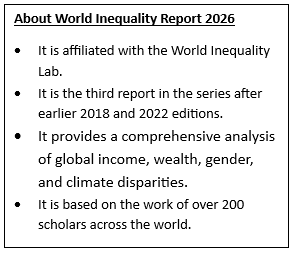
Context: Recently, the World Inequality Lab released its third World Inequality Report 2026, highlighting alarming levels of growing disparities in wealth and income globally.
Key Findings of the Report
• Global Findings
o Uneven wealth distribution: The Top 10 per cent owns three-quarters of all wealth, while the bottom 50 per cent holds just 2 per cent.
o Gender Pay gap persists: Excluding unpaid work, women earn only 61 per cent of what men earn per working hour, and when unpaid labor is included, this figure falls to just 32 per cent.
o Carbon emissions Inequality: The poorest half of the global population accounts for only 3 per cent of carbon emissions associated with private capital ownership, while the top 10 per cent account for 77 per cent of emissions.
o Unequal Global financial system: Each year, around 1% of global GDP (approximately three times as much as development aid) flows from poorer to richer nations through net foreign income transfers associated with persistent excess yields and lower interest payments on rich-country liabilities.
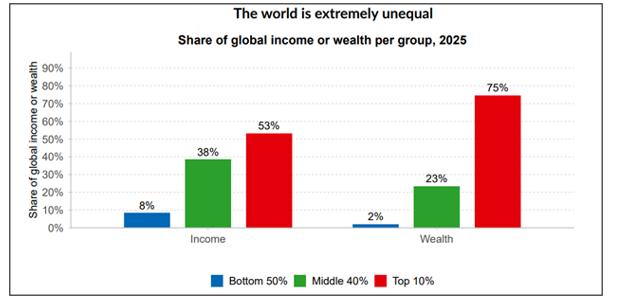
o Inequality between regions: Europe and much of North America & Oceania are among the least unequal. At the other end of the spectrum, Latin America, southern Africa, and the Middle East & North Africa combine low incomes for the bottom 50% with extreme concentration at the top.
• India-specific findings
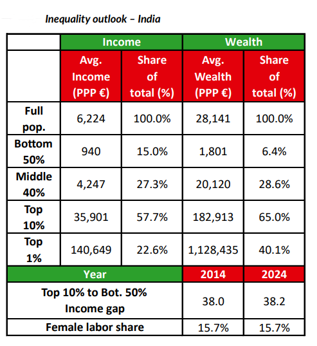
o Income inequality: Top 10 per cent of earners capturing 58 per cent of national income, while bottom 50 per cent receive only 15 per cent.
o Wealth inequality: The richest 10 per cent hold around 65 per cent of total wealth and the top 1 per cent hold about 40 per cent.
o Labor participation disparity: Female labor participation remains very low at 15.7%, showing no improvement over the past decade.
Key Recommendations of the Report
• Public investments in powerful equalisers: Public investment in free, high-quality schools, universal healthcare, childcare, and nutrition programs can reduce early-life disparities and foster lifelong learning opportunities.
• Redistributive programs: Cash transfers, pensions, unemployment benefits, and targeted support for vulnerable households can directly shift resources from the top to the bottom of the distribution.
• Advancing gender equality: Dismantle the structural barriers that shape how work is valued and distributed. Policies that recognize and redistribute unpaid care work, through affordable childcare, parental leave that includes fathers, and pension credits for caregivers, are essential to leveling the playing field.
• Fairer tax systems: Minimum wealth taxes on multi-millionaires raise the resources that could be mobilized to finance education, health, and climate adaptation.
• Reforming the Global financial system: Reforms such as adopting a global currency, centralized credit and debit systems, and corrective taxes on excessive surpluses would expand fiscal space for social investment and reduce the unequal exchange that has long defined global finance.

Indian Prime Minister's Visit to Jordan
World Inequality Report 2026
News in Short
The most trusted learning platform on your phone
With our training programs, learning online can be a very exciting experience! Take the next step toward achieving your professional and personal objectives


NCERT Books
Resources
We love learning. Through our innovative solutions, we encourage ourselves, our teams, and our Students to grow. We welcome and look for diverse perspectives and opinions because they enhance our decisions. We strive to understand the big picture and how we contribute to the company’s objectives. We approach challenges with optimism and harness the power of teamwork to accomplish our goals. These aren’t just pretty words to post on the office wall. This is who we are. It’s how we work. And it’s how we approach every interaction with each other and our Students.
Come with an open mind, hungry to learn, and you’ll experience unmatched personal and professional growth, a world of different backgrounds and perspectives, and the freedom to be you—every day. We strive to build and sustain diverse teams and foster a culture of belonging. Creating an inclusive environment where every students feels welcome, appreciated, and heard gives us something to feel (really) good about.
Get Free academic Counseling & Course Details