You're all caught up—no notifications available.
Explore All Exams at KGS


All Exams
Explore All Exams at KGS

Khan Sir Courses
Geography I Polity I History | World Map I Indian Map I Economics I Biology

UPSC & State PSC
UPSC I BPSC I UP-PSC I MP-PSC

State Exams
UP I Bihar I MP | Rajasthan

NEET | JEE | CUET | Boards
NEET | JEE | CUET | Boards

Defence Exams
NDA I CDS I CAPF I AFCAT I SSB I Agniveer

Police Exams
UP SI | Bihar SI | Delhi Police | UP Constable

SSC Exams
CGL I CPO I CHSL I MTS I SSC GD I Delhi Police

Foundation Courses
Physics I Chemistry I Biology I History I Geography I Polity I NCERT I Math I English | Map I Reasoning

Railway Exams
RRB | RPF

Teaching Exams
TET | Teaching | UGC

Banking Exams
SBI | RBI | IBPS

Engineering Exams
Civil | Electrical | Mechanical
UGC NET
UGC NET/JRF
Current Affairs provides you with the best compilation of the Daily Current Affairs taking place across the globe: National, International, Sports, Science and Technology, Banking, Economy, Agreement, Appointments, Ranks, and Report and General Studies

SYLLABUS
GS-2: Government policies and interventions for development in various sectors and issues arising out of their design and implementation
GS-3: Inclusive growth and issues arising from it
Context: Recently, IIM Bangalore and Protean release the inaugural ‘State of Digital Public Infrastructure in India’ report, mapping India’s DPI 2.0 future.
Key Highlights of the Report
• India’s “middle path” approach: The open and trusted public infrastructure enables private innovation at scale while maintaining inclusion, trust, and national priorities.
• Interoperability: The strength of India’s DPI lies not only in its scale but in its interoperability, a principle that allowed UPI, Aadhaar, and the Unified Health Interface to cut across bank systems, states, and departments.
• Growing Use of Digital Payments and Data Sharing:
• Digital IDs and Public Services: Aadhaar-based identity systems have made public services more efficient. For example, Direct Benefit Transfers (DBT) are now done for 328 schemes across 56 government ministries, improving transparency and reaching more people.
• Progress in Digital Healthcare: Healthcare is advancing, though slowly. Programs like the Ayushman Bharat Digital Mission (ABDM) issuing health IDs (ABHA IDs) and telemedicine services like e-Sanjeevani are helping in bring healthcare online and closer to people.
Challenges Highlighted in the Report
• Uneven maturity of DPI across sectors: While financial DPI has achieved near-universal penetration, digital skilling, health records, education platforms, and municipal services show wide regional disparities.
• Incentives & Institutional Motivation Gaps: Many potential stakeholders lack sufficient incentives to integrate with DPI platforms, hurting ecosystem growth.
• Poor DPI Adoption: Several states continue to lag in onboarding government departments to digital workflows, resulting in fragmented user experiences and delays in service delivery.
• Risk of Market Concentration & Private Dominance: DPI allows private players to build services on shared public platforms, but this also raises the risk of a few firms gaining excessive dominance, which can restrict competition and innovation.
Way Ahead
• Healthcare and some other sectors are still in early implementation stages and need better system integration, more provider involvement, and stronger incentives for growth.
• The report underscores the need for strong governance, privacy safeguards, and data protection, noting that the DPDP Act and DEPA will be crucial for enabling secure, user-friendly, and consent-based data sharing.
• There is urgent need for robust techno-legal regulatory frameworks to ensure DPI remains citizen-centric, transparent, accountable, and safe from misuse.
• For policymakers, the study provides a roadmap for what it calls “DPI 2.0,” a shift from infrastructure creation to user-centric governance.
About the Digital Public Infrastructure (DPI)
• Digital Public Infrastructure (DPI) is a set of foundational digital systems that forms the backbone of modern societies. DPI enables secure and seamless interactions between people, businesses and governments.
• DPIs enable faster, more efficient innovation by allowing various sectors to build on these shared, reusable digital building blocks to create new services.
• Key examples include digital identity, digital payments (like India's UPI), and secure data exchange platforms.
Sources:
IIMB
New Indian Express
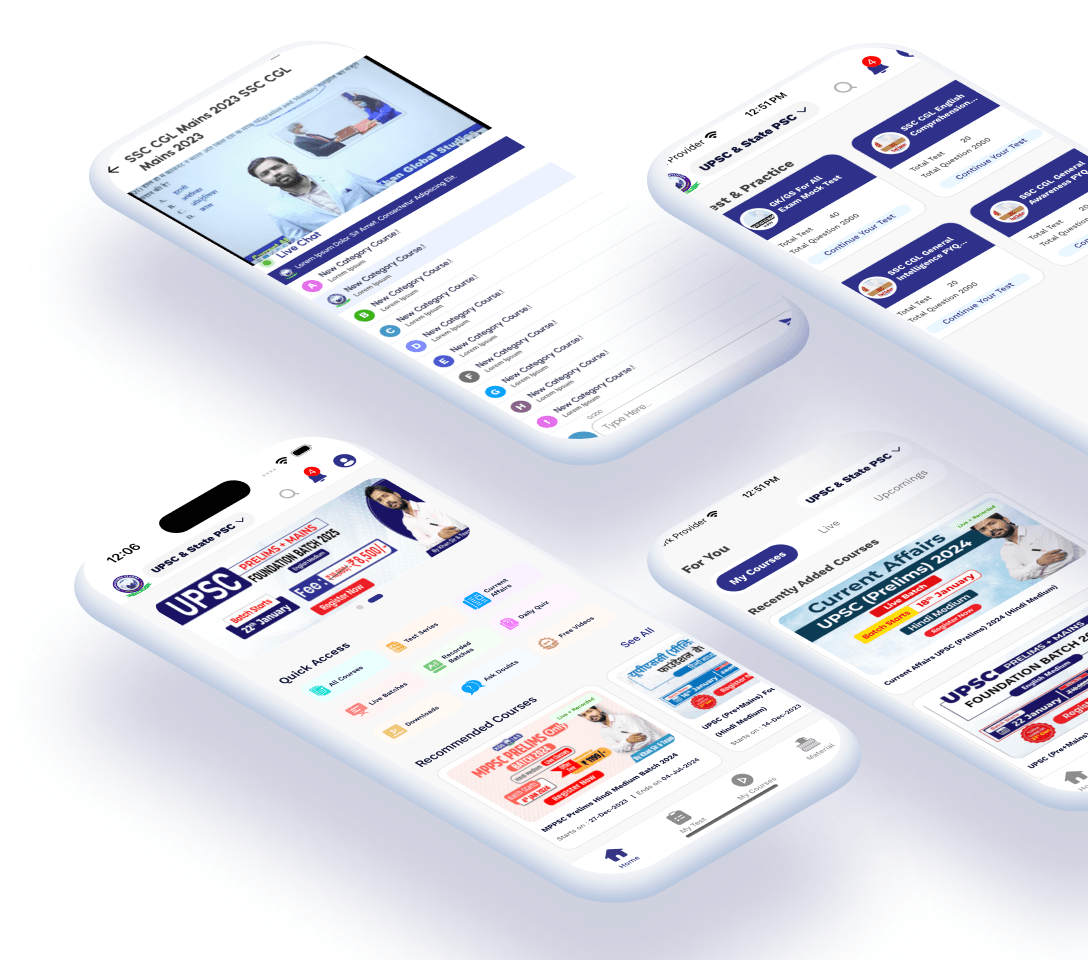
The most trusted learning platform on your phone
With our training programs, learning online can be a very exciting experience! Take the next step toward achieving your professional and personal objectives



NCERT Books
Resources
We love learning. Through our innovative solutions, we encourage ourselves, our teams, and our Students to grow. We welcome and look for diverse perspectives and opinions because they enhance our decisions. We strive to understand the big picture and how we contribute to the company’s objectives. We approach challenges with optimism and harness the power of teamwork to accomplish our goals. These aren’t just pretty words to post on the office wall. This is who we are. It’s how we work. And it’s how we approach every interaction with each other and our Students.
Come with an open mind, hungry to learn, and you’ll experience unmatched personal and professional growth, a world of different backgrounds and perspectives, and the freedom to be you—every day. We strive to build and sustain diverse teams and foster a culture of belonging. Creating an inclusive environment where every students feels welcome, appreciated, and heard gives us something to feel (really) good about.
Get Free academic Counseling & Course Details