You're all caught up—no notifications available.
Explore All Exams at KGS


All Exams
Explore All Exams at KGS

Khan Sir Courses
Geography I Polity I History | World Map I Indian Map I Economics I Biology

UPSC & State PSC
UPSC I BPSC I UP-PSC I MP-PSC

State Exams
UP I Bihar I MP | Rajasthan

NEET | JEE | CUET
NEET | JEE | CUET

Defence Exams
NDA I CDS I CAPF I AFCAT I SSB I Agniveer

Police Exams
UP SI | Bihar SI | Delhi Police | UP Constable

SSC Exams
CGL I CPO I CHSL I MTS I SSC GD I Delhi Police

Foundation Courses
Physics I Chemistry I Biology I History I Geography I Polity I NCERT I Math I English | Map I Reasoning

Railway Exams
RRB | RPF

Teaching Exams
TET | Teaching | UGC

Banking Exams
SBI | RBI | IBPS

Engineering Exams
Civil | Electrical | Mechanical
UGC NET
UGC NET/JRF
Current Affairs provides you with the best compilation of the Daily Current Affairs taking place across the globe: National, International, Sports, Science and Technology, Banking, Economy, Agreement, Appointments, Ranks, and Report and General Studies

SYLLABUS
GS-2: Effect of policies and politics of developed and developing countries on India’s interests, Indian diaspora.
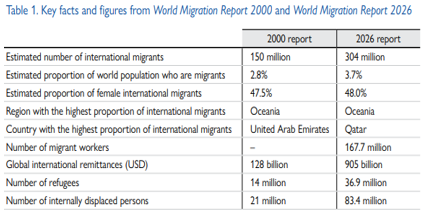
Context: The International Organization for Migration released the World Migration Report 2026, highlighting global migration trends, major migration corridors, displacement patterns, and the growing role of migration in development and geopolitics.
About the Report
• The World Migration Report 2026 is the thirteenth edition of the flagship report published by the International Organization for Migration to improve understanding of migration and mobility worldwide.
• The report is divided into two parts:
• It examines migration trends in the context of geopolitical tensions, environmental degradation, technological change, demographic shifts, and humanitarian crises, while also highlighting the developmental role of migrants and diasporas.
Key Findings of the Report
• Around 304 million people were living outside their country of birth by mid-2024, accounting for 3.7% of the global population, compared to 2.9% in 1990.
• The Mexico–United States corridor remained the world’s largest migration corridor with around 11 million migrants. Other major corridors included:
• The India–United Arab Emirates corridor became the fifth-largest migration corridor globally, driven mainly by migrant workers.
• The India–United States corridor ranked as the sixth-largest migration corridor in the world and the second-largest involving North America after the Mexico–U.S. corridor.
• Around 3.2 million Indian migrants were living in the United States in 2024, making Indians the second-largest foreign-born group after Mexicans.
• The report highlighted the growing influence of the Indian diaspora in the United States in strengthening India–U.S. relations through organisations such as the United States–India Political Action Committee (USINPAC), particularly in areas like trade, defence cooperation, and visa policies.
• Other major Asian migration corridors included:
• Migration from South Asian countries such as India, Bangladesh, Pakistan, and Myanmar remained predominantly male-dominated, mainly due to labour migration towards Gulf and South-East Asian countries in sectors such as construction, manufacturing, and agriculture.
• Gulf countries such as the United Arab Emirates, Saudi Arabia, and Kuwait recorded a significantly higher proportion of male immigrants, while India had a relatively higher share of female immigrants.
• Global displacement continued to rise sharply:
• International remittances reached approximately USD 905 billion in 2024, including USD 685 billion to low- and middle-income countries, highlighting migration’s contribution to development.
• Major conflicts contributing to displacement included Sudan, Ukraine, Gaza, Myanmar, Syria, Yemen, and the Democratic Republic of Congo.
• Climate change and environmental degradation increasingly contributed to migration through droughts, floods, storms, wildfires, and rising temperatures, particularly affecting vulnerable populations and poor countries.
• The report highlighted the growing use of Artificial Intelligence (AI) in migration governance, including border management, visa processing, and identity systems, while warning about risks related to bias, privacy, digital inequality, and labour displacement.
Report Recommendations
• Promote safe, regular, and legal migration pathways to reduce irregular migration and exploitation.
• Strengthen rights-based and evidence-driven migration governance.
• Reduce remittance transfer costs and improve financial inclusion for migrants.
• Promote skills partnerships, circular migration, and diaspora engagement for development.
• Integrate migration policies with climate adaptation, labour market planning, and social protection systems.
• Enhance international cooperation for refugee protection, displacement response, and migration data systems.
• Counter xenophobia, misinformation, and anti-migrant discrimination through inclusive policies and public awareness.
The most trusted learning platform on your phone
With our training programs, learning online can be a very exciting experience! Take the next step toward achieving your professional and personal objectives


Course Related Query:
Ask Your DoubtsStore Related Query:store@khanglobalstudies.comNCERT Books
Resources
We love learning. Through our innovative solutions, we encourage ourselves, our teams, and our Students to grow. We welcome and look for diverse perspectives and opinions because they enhance our decisions. We strive to understand the big picture and how we contribute to the company’s objectives. We approach challenges with optimism and harness the power of teamwork to accomplish our goals. These aren’t just pretty words to post on the office wall. This is who we are. It’s how we work. And it’s how we approach every interaction with each other and our Students.
Come with an open mind, hungry to learn, and you’ll experience unmatched personal and professional growth, a world of different backgrounds and perspectives, and the freedom to be you—every day. We strive to build and sustain diverse teams and foster a culture of belonging. Creating an inclusive environment where every students feels welcome, appreciated, and heard gives us something to feel (really) good about.
Get Free academic Counseling & Course Details