You're all caught up—no notifications available.
Explore All Exams at KGS


All Exams
Explore All Exams at KGS

Khan Sir Courses
Geography I Polity I History | World Map I Indian Map I Economics I Biology

UPSC & State PSC
UPSC I BPSC I UP-PSC I MP-PSC

State Exams
UP I Bihar I MP | Rajasthan

NEET | JEE | CUET | Boards
NEET | JEE | CUET | Boards

Defence Exams
NDA I CDS I CAPF I AFCAT I SSB I Agniveer

Police Exams
UP SI | Bihar SI | Delhi Police | UP Constable

SSC Exams
CGL I CPO I CHSL I MTS I SSC GD I Delhi Police

Foundation Courses
Physics I Chemistry I Biology I History I Geography I Polity I NCERT I Math I English | Map I Reasoning

Railway Exams
RRB | RPF

Teaching Exams
TET | Teaching | UGC

Banking Exams
SBI | RBI | IBPS

Engineering Exams
Civil | Electrical | Mechanical
UGC NET
UGC NET/JRF
Current Affairs provides you with the best compilation of the Daily Current Affairs taking place across the globe: National, International, Sports, Science and Technology, Banking, Economy, Agreement, Appointments, Ranks, and Report and General Studies

SYLLABUS
GS-3: Awareness in the fields of Space and challenges to internal security through communication networks, role of media and social networking sites in internal security challenges, basics of cyber security; money-laundering and its prevention.
Context: India’s indigenous navigation system, Navigation with Indian Constellation (NavIC), has suffered another setback after the failure of the atomic clock onboard IRNSS-1F, leading to the loss of its positioning capability.
More on the News
• The Indian Space Research Organisation (ISRO) recently confirmed that the last functional atomic clock onboard IRNSS-1F stopped working on March 13, 2026.
• The satellite, launched in March 2016, had already completed its design mission life of 10 years, and had been operating with only one working clock out of three for some time.
• Though it can continue one-way messaging services, it can no longer provide Position, Navigation and Timing (PNT) services.
• With this failure, only three satellites (IRNSS-1B, IRNSS-1L, NVS-01) are currently providing navigation services.
• Minimum four satellites are required for effective navigation coverage, raising concerns over service reliability.
About NavIC (IRNSS)
• NavIC (Navigation with Indian Constellation), originally known as the Indian Regional Navigation Satellite System (IRNSS), is India’s indigenous satellite-based navigation system developed by ISRO.
• The system was conceived in the aftermath of the 1999 Kargil War, when India faced denial of access to the U.S.-controlled GPS, highlighting the strategic need for an independent navigation capability.
• NavIC was designed as a regional navigation system consisting of seven satellites, intended to provide accurate positioning services over the entire Indian landmass, and up to 1,500 km beyond India’s borders.
• Unlike global systems such as GPS, NavIC satellites are placed in geosynchronous orbits directly above the Indian region, ensuring better signal availability and accuracy, especially in challenging terrains like mountain valleys, forests, and dense urban areas.
• The system is capable of providing location accuracy of around 10 metres, making it highly reliable for both civilian and strategic applications.
• Applications: Navigation (land, air, sea), Disaster management, Vehicle tracking, Military operations, Mapping & geodesy, and timing for telecom & financial systems.
• The newer generation of satellites has introduced L1 frequency signals, in addition to L5 and S bands, enabling better interoperability with global systems like GPS and wider adoption in consumer devices.
Current and Earlier Operational Satellites
• India has launched around 11 satellites under the NavIC programme since 2013, but the constellation has faced persistent reliability issues.
• At present, the satellites capable of providing navigation (PNT) services are:
• Earlier satellites such as IRNSS-1A, 1C, 1D, 1E, and 1G suffered failures primarily due to atomic clock malfunctions. IRNSS-1F is the latest addition to this list.
• The latest failure is expected to impact critical applications such as railway tracking, aviation navigation, disaster response, and military operations, where NavIC has been increasingly integrated.
Issues and Challenges in NavIC
• Atomic Clock Failures: Multiple satellites (at least six) have suffered atomic clock failures; early reliance on imported clocks led to repeated breakdowns.
• Ageing Satellite Constellation: Several first-generation satellites are nearing or have crossed their 10-year design life, reducing reliability.
• Reduced Operational Strength: The system is currently functioning below the minimum required satellite strength, with only a few fully operational satellites, affecting accuracy and coverage.
• Launch Failures and Delays: PSLV mission setbacks and orbital issues (e.g., NVS-02) have delayed timely replacement and constellation expansion.
• Institutional and Development Delays: The CAG (2018) flagged delays in user receiver development, leading to underutilisation of available satellite capacity.
• Limited Adoption: Despite growing use (railways, smartphones), NavIC still lags behind global systems like GPS in widespread adoption.
About Atomic Clocks and Their Significance
• Atomic clocks form the core of any satellite navigation system, including NavIC.
• They provide extremely precise time measurements, which are essential for determining a user’s location.
• Satellite navigation works by calculating the time taken by signals to travel from satellites to a receiver on Earth.
• Since signals travel at the speed of light, even a tiny error in time measurement can lead to massive positional errors, sometimes running into hundreds of kilometres.
• Each NavIC satellite carries three atomic clocks (typically Rubidium clocks) to ensure redundancy and reliability.
• These clocks generate precise timing signals that serve as the reference for navigation calculations.
• Impact of Clock Failure:
• ISRO is developing indigenous atomic clocks, now deployed in second-generation satellites like NVS-01, to:
• Technologies such as the Atomic Clock Monitoring Unit (ACMU) enhance performance by correcting frequency drifts and maintaining high timing stability.
Sources:
India Express
India Express
The Hindu
Ecomomic Times
First Post

NavIC Faces Setback After Failure of IRNSS-1F Satellite
Project Great Indian Bustard (GIB)
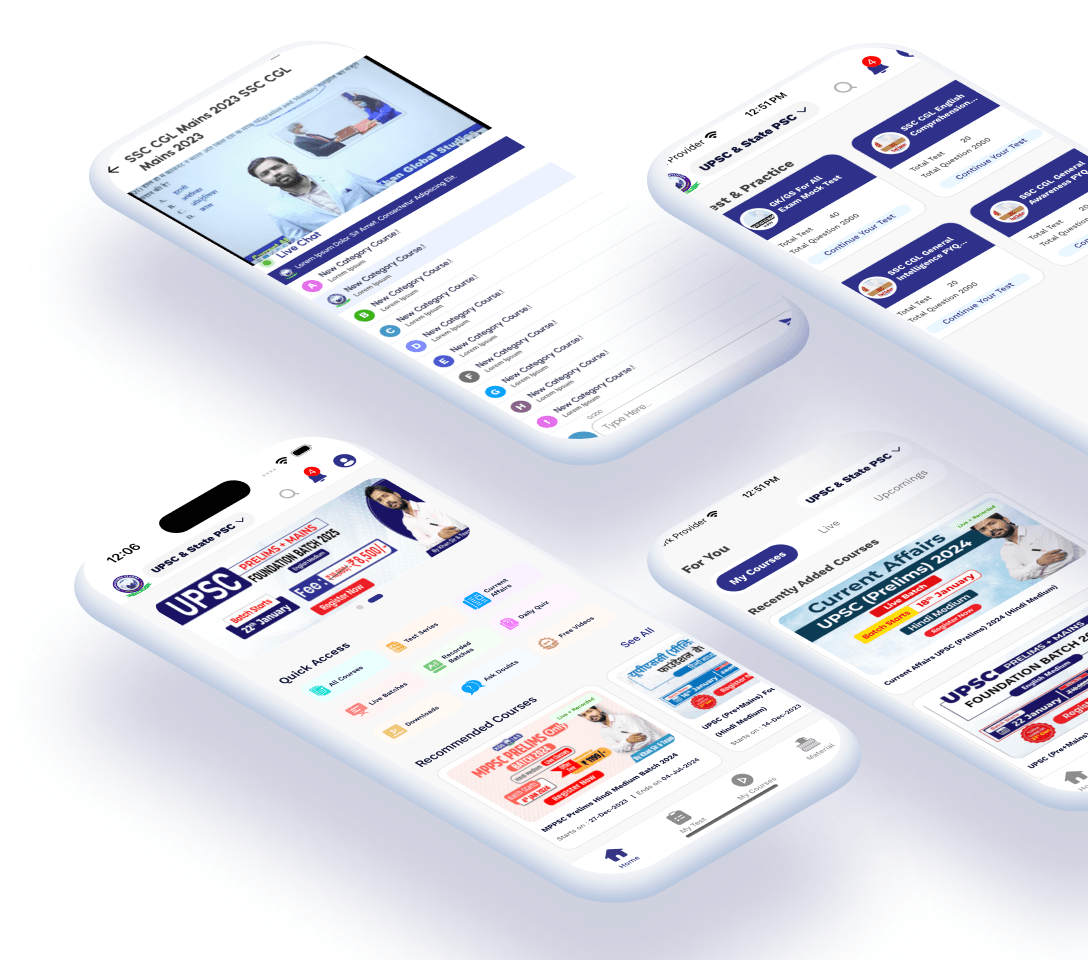
The most trusted learning platform on your phone
With our training programs, learning online can be a very exciting experience! Take the next step toward achieving your professional and personal objectives



Course Related Query:
Ask Your DoubtsStore Related Query:store@khanglobalstudies.comNCERT Books
Resources
We love learning. Through our innovative solutions, we encourage ourselves, our teams, and our Students to grow. We welcome and look for diverse perspectives and opinions because they enhance our decisions. We strive to understand the big picture and how we contribute to the company’s objectives. We approach challenges with optimism and harness the power of teamwork to accomplish our goals. These aren’t just pretty words to post on the office wall. This is who we are. It’s how we work. And it’s how we approach every interaction with each other and our Students.
Come with an open mind, hungry to learn, and you’ll experience unmatched personal and professional growth, a world of different backgrounds and perspectives, and the freedom to be you—every day. We strive to build and sustain diverse teams and foster a culture of belonging. Creating an inclusive environment where every students feels welcome, appreciated, and heard gives us something to feel (really) good about.
Get Free academic Counseling & Course Details