Explore All Exams at KGS


All Exams
Explore All Exams at KGS

Khan Sir Courses
Geography I Polity I History | World Map I Indian Map I Economics I Biology

UPSC & State PSC
UPSC I BPSC I UP-PSC I MP-PSC

Judiciary
CLAT

State Exams
UP I Bihar I MP | Rajasthan

NEET | JEE | CUET
NEET | JEE | CUET

Defence Exams
NDA I CDS I CAPF I AFCAT I SSB I Agniveer

Police Exams
UP SI | Bihar SI | Delhi Police | UP Constable

SSC Exams
CGL I CPO I CHSL I MTS I SSC GD I Delhi Police

Foundation Courses
Physics I Chemistry I Biology I History I Geography I Polity I NCERT I Math I English | Map I Reasoning

Railway Exams
RRB | RPF

Teaching Exams
TET | Teaching | UGC

Banking Exams
SBI | RBI | IBPS

Engineering Exams
Civil | Electrical | Mechanical
UGC NET
UGC NET/JRF
Current Affairs provides you with the best compilation of the Daily Current Affairs taking place across the globe: National, International, Sports, Science and Technology, Banking, Economy, Agreement, Appointments, Ranks, and Report and General Studies
Current Affairs
SYLLABUS
GS-2: Issues relating to development and management of Social Sector/Services relating to Health; Issues relating to poverty and hunger; Welfare Schemes for Vulnerable Sections of the Population by the Centre and States and the Performance of these Schemes.
Context: Ayushman Bharat completed eight years on 23 September 2026, marking the expansion of financial protection, primary healthcare and digital health infrastructure as India pursues Universal Health Coverage.
More on the News
• Launched on 23 September 2018, Ayushman Bharat was designed to advance Universal Health Coverage (UHC) by improving access to affordable healthcare and protecting vulnerable households from high medical expenditure.
• According to the latest government assessment, more than 60 crore beneficiaries have access to annual health cover of up to ₹5 lakh, while Ayushman Arogya Mandirs have recorded over 540 crore visits, strengthening primary healthcare at the grassroots.
• As of 31 August 2026, AB-PMJAY had facilitated around 13.25 crore hospital admissions worth ₹2.03 lakh crore through more than 38,000 empanelled public and private hospitals.
Understanding Ayushman Bharat
• Ayushman Bharat is a broader healthcare architecture rather than merely a health-insurance scheme.
• It was initially launched with two inter-related components—Health and Wellness Centres, now called Ayushman Arogya Mandirs (AAMs), and Pradhan Mantri Jan Arogya Yojana (AB-PMJAY).
• It has subsequently expanded into a four-component framework comprising AAMs, AB-PMJAY, PM-Ayushman Bharat Health Infrastructure Mission (PM-ABHIM) and Ayushman Bharat Digital Mission (ABDM).
Universal Health Coverage and Ayushman Bharat
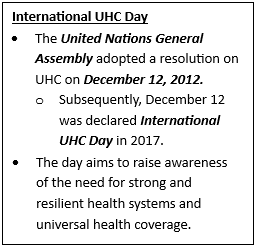
• The WHO defines UHC as ensuring that all people can access the full range of quality health services they need, when and where they need them, without financial hardship. It covers health promotion, prevention, treatment, rehabilitation and palliative care across the life course.
• UHC is rooted in the principles of equity, non-discrimination, and the right to health. Sustainable Development Goal (SDG) Target 3.8 aims at attaining UHC by 2030.
• Adopted in 1978, the Alma-Ata Declaration identified primary health care as the key to the attainment of the goal of Health for All.
• The idea of UHC in India dates back to the Bhore Committee report, which in 1946 recommended a health system for India that integrates preventive and curative care along with access to medical care regardless of ability to pay for all.
• Ayushman Bharat addresses different dimensions of UHC: AB-PMJAY provides financial protection for hospitalisation; AAMs expand comprehensive primary care; ABDM supports continuity and portability of care; and PM-ABHIM strengthens health-system capacity and preparedness.
Eight Years of Expansion and Impact
• Financial protection: By 31 August 2026, AB-PMJAY had supported 13.25 crore hospital admissions worth ₹2.03 lakh crore. The expansion to senior citizens aged 70 years and above and specified groups such as ASHAs, Anganwadi Workers and Helpers has widened the scheme's beneficiary base.
• Primary healthcare: AAMs recorded over 540 crore cumulative visits, while more than 50 crore teleconsultations had been conducted through the broader telemedicine network by September 2026. Their expanded service package brings preventive, promotive, curative, rehabilitative and palliative care closer to communities.
• Digital health: As of 17 September 2026, more than 97.61 crore ABHA IDs were operational, and over 119.95 crore health records had been linked to them. This supports portability and continuity of care through consent-based digital health information exchange.
• Reducing financial burden: The share of Out-of-Pocket Expenditure (OOPE) in Total Health Expenditure declined from 62.6% in 2014–15 to 43.4% in 2022–23. The government attributes this broader decline to increased public health spending and expansion of publicly financed health insurance schemes, including AB-PMJAY.
Gaps and Challenges
• Public financing remains below the policy target: Government Health Expenditure increased to 1.43% of GDP in 2022–23, but remains below the 2.5% of GDP target envisaged under the National Health Policy, 2017. This constrains sustained investment in infrastructure, workforce and service delivery.
• Household financial burden persists: Although the share of Out-of-Pocket Expenditure (OOPE) in Total Health Expenditure declined substantially from 64.2% in 2013–14 to 43.4% in 2022–23, households still finance a significant portion of healthcare directly. This indicates that expanding publicly financed coverage has not eliminated financial hardship.
• Service coverage remains incomplete: India's latest available WHO UHC Service Coverage Index was 63 in 2021 on a 0–100 scale, while the NCD sub-index stood at 54, highlighting continuing gaps in effective coverage of essential services.
• Human-resource and geographical gaps: Despite a 1:811 doctor-population ratio, workforce availability remains uneven, with PHCs having 40,583 doctors/medical officers and CHCs 26,280 specialists/medical officers.
Way Forward
• Strengthen primary healthcare: Consolidate AAMs as the first point of contact for preventive, promotive and chronic-care services, reducing avoidable pressure on secondary and tertiary facilities.
• Deepen financial protection: Complement hospitalisation coverage with stronger public provision of medicines, diagnostics and outpatient care, which remain important components of household health expenditure.
• Increase and sustain public investment: Move towards the 2.5% of GDP public-health expenditure target while improving the efficiency and equitable distribution of resources.
• Address workforce and regional disparities: Improve availability of trained health personnel, particularly specialists in underserved rural and remote areas, alongside better referral and telemedicine networks.
Khan Global Studies App
With our training programs, learning online can be a very exciting experience. Take the next step toward achieving your professional and personal objectives.



Course Related Query:
Ask Your DoubtsStore Related Query:store@khanglobalstudies.comNEET | JEE | CUET
NCERT Books
Resources
We love learning. Through our innovative solutions, we encourage ourselves, our teams, and our Students to grow. We welcome and look for diverse perspectives and opinions because they enhance our decisions. We strive to understand the big picture and how we contribute to the company’s objectives. We approach challenges with optimism and harness the power of teamwork to accomplish our goals. These aren’t just pretty words to post on the office wall. This is who we are. It’s how we work. And it’s how we approach every interaction with each other and our Students.
Come with an open mind, hungry to learn, and you’ll experience unmatched personal and professional growth, a world of different backgrounds and perspectives, and the freedom to be you—every day. We strive to build and sustain diverse teams and foster a culture of belonging. Creating an inclusive environment where every students feels welcome, appreciated, and heard gives us something to feel (really) good about.