You're all caught up—no notifications available.
Explore All Exams at KGS


All Exams
Explore All Exams at KGS

Khan Sir Courses
Geography I Polity I History | World Map I Indian Map I Economics I Biology

UPSC & State PSC
UPSC I BPSC I UP-PSC I MP-PSC

State Exams
UP I Bihar I MP | Rajasthan

NEET | JEE | CUET
NEET | JEE | CUET

Defence Exams
NDA I CDS I CAPF I AFCAT I SSB I Agniveer

Police Exams
UP SI | Bihar SI | Delhi Police | UP Constable

SSC Exams
CGL I CPO I CHSL I MTS I SSC GD I Delhi Police

Foundation Courses
Physics I Chemistry I Biology I History I Geography I Polity I NCERT I Math I English | Map I Reasoning

Railway Exams
RRB | RPF

Teaching Exams
TET | Teaching | UGC

Banking Exams
SBI | RBI | IBPS

Engineering Exams
Civil | Electrical | Mechanical
UGC NET
UGC NET/JRF
Current Affairs provides you with the best compilation of the Daily Current Affairs taking place across the globe: National, International, Sports, Science and Technology, Banking, Economy, Agreement, Appointments, Ranks, and Report and General Studies

SYLLABUS
GS-3: Conservation, environmental pollution and degradation; Infrastructure: Energy, Ports.
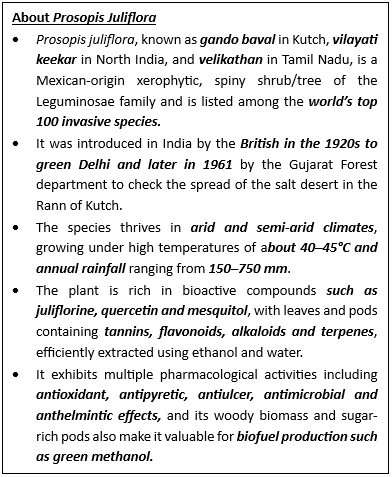
Context: India is building its first green methanol production plant at Kandla port, converting the invasive weed Prosopis juliflora into clean marine fuel, marking a significant step in the country’s energy transition and maritime decarbonisation journey.
About the Green Methanol Plant
• The plant is located at Deendayal Port Authority and is being built by Thermax Limited using gasification technology from Ankur Scientific Energy Technologies, owned by the port authority.
• It will produce five tonnes of methanol per day as a demonstration project.
• Production Process:
The plant is also certified to run on other agricultural residues such as bagasse and cotton stalk.
• Methanol is used in shipping as a cleaner alternative to heavy “bunker oil.” While conventional methanol is derived from fossil fuels such as gas or coal, green methanol uses biomass.
Significance of the Plant
• Environmental Benefits: According to Methanol Institute, green methanol can cut a vessel’s CO₂ emissions by up to 95%, reduce NOx by up to 80%, and eliminate sulphur oxides and particulate matter. This makes it a highly effective alternative to conventional marine bunker fuel.
• National Energy Security: Ankur Scientific estimates that agricultural residues like bagasse and cotton stalk, at their maximum potential, could displace up to one-third of India’s oil imports.
• Policy Alignment: The plant aligns with several national frameworks:
• Ecological Restoration The plant provides the first compelling economic reason to clear Prosopis juliflora, which has devastated Kutch's Banni grasslands for decades — turning an ecological liability into a national energy asset.
Challenges
• Cost Gap: Green methanol (~$700–800/tonne) and e-methanol (~$2,000/tonne) remain significantly more expensive than conventional methanol (₹30/kg pre-Ukraine war and ₹70–80/kg post-war), making adoption largely penalty-driven under EU regulations rather than price-driven.
• Scale Limitation: The current 5 TPD demonstration plant is far below the 100–500 TPD scale required for commercial viability, although the APL 150 TPD plant begins to address this gap.
• Energy Source Issue: The plant currently relies on conventional grid electricity for operations, and meeting global carbon-intensity norms will require a transition to fully renewable power.
• Water–Energy–Food Nexus: India’s fragmented policy system, including subsidised electricity leading to excessive groundwater extraction (over 1 metre annual decline in some regions) and ₹1.5 lakh crore annual subsidies, creates structural barriers to a sustainable energy transition.
Way Forward
• Adopt Renewable Energy: Grid electricity must be replaced with renewable sources such as solar and wind to meet international carbon-intensity standards.
• Diversify Feedstock: Agricultural residues like bagasse and cotton stalk should be treated as national energy assets to scale production and reduce oil import dependence.
• Strengthen Policy Support: Existing measures such as the flat 30% subsidy for green-fuel vessels (August 2023), green port guidelines, and the hydrogen mission must be deepened and consistently implemented.
• Integrated Policy Reform: Water, energy, and agriculture policies must be governed through a unified nexus-based framework with pricing reforms and smart metering to ensure long-term resilience.
The most trusted learning platform on your phone
With our training programs, learning online can be a very exciting experience! Take the next step toward achieving your professional and personal objectives



Course Related Query:
Ask Your DoubtsStore Related Query:store@khanglobalstudies.comNCERT Books
Resources
We love learning. Through our innovative solutions, we encourage ourselves, our teams, and our Students to grow. We welcome and look for diverse perspectives and opinions because they enhance our decisions. We strive to understand the big picture and how we contribute to the company’s objectives. We approach challenges with optimism and harness the power of teamwork to accomplish our goals. These aren’t just pretty words to post on the office wall. This is who we are. It’s how we work. And it’s how we approach every interaction with each other and our Students.
Come with an open mind, hungry to learn, and you’ll experience unmatched personal and professional growth, a world of different backgrounds and perspectives, and the freedom to be you—every day. We strive to build and sustain diverse teams and foster a culture of belonging. Creating an inclusive environment where every students feels welcome, appreciated, and heard gives us something to feel (really) good about.
Get Free academic Counseling & Course Details