KGS

All Exams

Explore All Exams at KGS

All Exams
Current Affairs made simple.

Current Affairs provides you with the best compilation of the Daily Current Affairs taking place across the globe: National, International, Sports, Science and Technology, Banking, Economy, Agreement, Appointments, Ranks, and Report and General Studies

Current Affairs

Make in India Completes 12 Years

SYLLABUS

GS-3: Indian Economy and issues relating to planning, mobilization of resources, growth, development and employment.

Context: As Make in India completes 12 years on 25 September 2026, India’s manufacturing landscape has expanded across key industries, components, machinery, strategic materials and advanced technologies.

About Make in India 
  • Make in India was launched on 25 September 2014 to position India as a global hub for manufacturing, design and innovation by facilitating investment, fostering innovation and developing world-class infrastructure.
  • Guided by “Minimum Government, Maximum Governance”, it also focuses on modernising processes and policies.
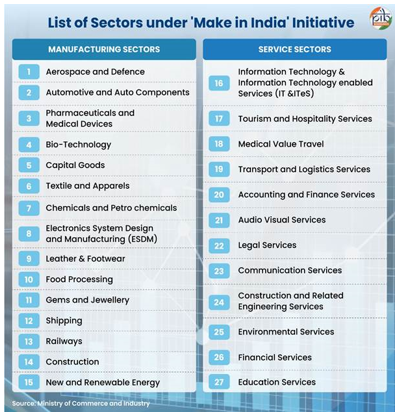
  • Under Make in India 2.0, the initiative now covers 27 sectors, including 15 manufacturing and 12 services sectors, with 24 sub-sectors identified based on industrial strengths, import-substitution potential, export potential and employment opportunities.

Achievements of Make in India

  • Growth of Manufacturing and Key Industries: Manufacturing GVA recorded a 10.88% CAGR between 2022-23 and 2025-26, while manufacturing IIP increased by 7% during April-July 2026.
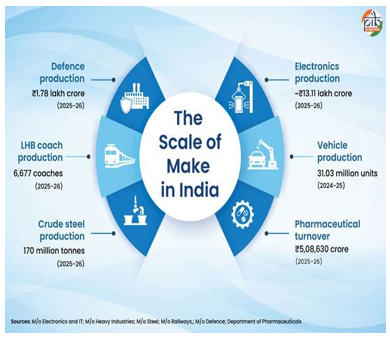
    Electronics production rose nearly seven-fold, mobile-phone production increased to around ₹6.3 lakh crore, and vehicle production reached 31.03 million units in 2024-25. 
  • Expansion of Pharmaceuticals, Steel, Railways and Defence: India ranks third globally in pharmaceutical volume and 11th by value, while crude steel production increased from 81.7 million tonnes in 2014-15 to 170 million tonnes in 2025-26.
    Indigenous defence production rose from ₹46,429 crore to ₹1.78 lakh crore during the same period.
  • Deepening Indigenous Technology and Strategic Capabilities: India has expanded manufacturing beyond final products into space microprocessors, rare-earth permanent magnets, solar cells and modules, electric-vehicle drive systems, aircraft, railway components and nuclear components, strengthening domestic technological and strategic capabilities.
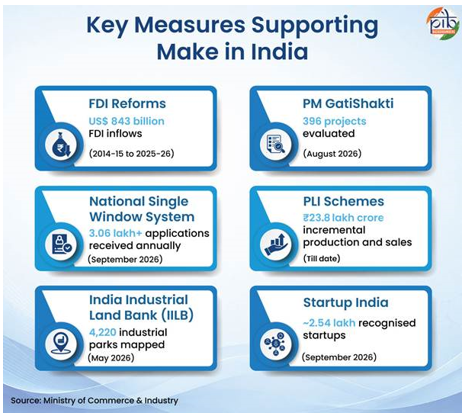
  • Investment and Infrastructure Support: Cumulative FDI reached USD 843 billion during 2014-15 to 2025-26, while the National Single Window System provides access to over 327 Central and 3,452 State approvals.
    The India Industrial Land Bank had mapped 4,220 industrial parks, and PM GatiShakti had evaluated 396 projects worth around ₹18.66 lakh crore.
  • PLI and New Strategic Manufacturing Initiatives: PLI schemes covering 14 sectors had attracted around ₹2.6 lakh crore investment, generated ₹23.8 lakh crore in production and sales, supported over ₹15.5 lakh crore in exports and created around 14.6 lakh jobs
    New initiatives such as Semicon 2.0, BHAVYA, the Mobile Phone Manufacturing Scheme and the Rare Earth Permanent Magnets Scheme seek to deepen strategic manufacturing.

Need and Significance 

  • Strengthening Domestic Manufacturing: A strong manufacturing base is essential for higher economic growth, domestic value addition and a deeper industrial ecosystem.
  • Employment Generation: Manufacturing expansion can create employment for India’s large labour force and generate opportunities across industrial supply chains.
  • Reducing Import Dependence: Developing domestic capabilities in components, machinery, electronics and strategic materials can reduce import dependence and strengthen supply-chain resilience.
  • Promoting Exports: Higher production and domestic value addition can help India increase manufacturing exports and integrate more deeply with global value chains.
  • Strategic and Technological Self-Reliance: Domestic capabilities in semiconductors, defence, space, rare-earth magnets and advanced pharmaceuticals can strengthen technological and strategic self-reliance.

Gaps / Challenges

  • Limited Rise in Manufacturing Share: Despite higher output, manufacturing’s share in overall GVA under the new series increased only marginally from 14.6% in 2022-23 to 15.6% in 2025-26.
  • Limited Employment Impact: Manufacturing employment increased from around 5.1 crore in 2016-17 to 5.3 crore in 2025-26, while its share in total employment remained broadly similar.
  • Concentration of PLI Benefits: PLI benefits remain concentrated, with the top five sectors accounting for nearly 83% of total PLI investment, indicating limited spread across the wider manufacturing base.
  • Weak Private Investment: Private-sector fixed investment remains subdued, while manufacturing capacity utilisation has remained below the 80% level generally associated with stronger incentives for fresh capacity creation.
  • Global Competitiveness and Structural Constraints: India continues to face challenges related to import dependence, infrastructure and logistics costs, skill gaps, regulatory issues, production costs and competition from countries such as China, Vietnam and Indonesia.

Khan Global Studies App

The most trusted learning platform on your phone

With our training programs, learning online can be a very exciting experience. Take the next step toward achieving your professional and personal objectives.


Download on the App StoreGet it on Google Play
KGS learning dashboard and mobile application
logo
Khan Global Studies Pvt. Ltd. 5th Floor,
A13A, Graphix 1 Tower B, Sector 62,
Noida, Uttar Pradesh 201309

Course Related Query:

Ask Your DoubtsStore Related Query:store@khanglobalstudies.com

Get Free Academic Counseling & Course Details

KGS best learning platform

About Khan Global Studies

We love learning. Through our innovative solutions, we encourage ourselves, our teams, and our Students to grow. We welcome and look for diverse perspectives and opinions because they enhance our decisions. We strive to understand the big picture and how we contribute to the company’s objectives. We approach challenges with optimism and harness the power of teamwork to accomplish our goals. These aren’t just pretty words to post on the office wall. This is who we are. It’s how we work. And it’s how we approach every interaction with each other and our Students.


What Makes Us Different

Come with an open mind, hungry to learn, and you’ll experience unmatched personal and professional growth, a world of different backgrounds and perspectives, and the freedom to be you—every day. We strive to build and sustain diverse teams and foster a culture of belonging. Creating an inclusive environment where every students feels welcome, appreciated, and heard gives us something to feel (really) good about.

©Copyright 2026 KhanGlobalStudies

Make in India Completes 12 Years | Current Affairs