Explore All Exams at KGS


All Exams
Explore All Exams at KGS

Khan Sir Courses
Geography I Polity I History | World Map I Indian Map I Economics I Biology

UPSC & State PSC
UPSC I BPSC I UP-PSC I MP-PSC

State Exams
UP I Bihar I MP | Rajasthan

NEET | JEE | CUET
NEET | JEE | CUET

Defence Exams
NDA I CDS I CAPF I AFCAT I SSB I Agniveer

Police Exams
UP SI | Bihar SI | Delhi Police | UP Constable

SSC Exams
CGL I CPO I CHSL I MTS I SSC GD I Delhi Police

Foundation Courses
Physics I Chemistry I Biology I History I Geography I Polity I NCERT I Math I English | Map I Reasoning

Railway Exams
RRB | RPF

Teaching Exams
TET | Teaching | UGC

Banking Exams
SBI | RBI | IBPS

Engineering Exams
Civil | Electrical | Mechanical
UGC NET
UGC NET/JRF
Current Affairs provides you with the best compilation of the Daily Current Affairs taking place across the globe: National, International, Sports, Science and Technology, Banking, Economy, Agreement, Appointments, Ranks, and Report and General Studies
Current Affairs
SYLLABUS
GS-2: Functions and Responsibilities of the Union and the States, Issues and Challenges Pertaining to the Federal Structure.
Context: Six Yamuna-basin States/UT signed an agreement on 15 September 2026 for the long-pending Kishau Multipurpose Project, paving the way for its implementation.
Key Highlights of the Agreement
• Six signatories: Himachal Pradesh, Uttarakhand, Uttar Pradesh, Haryana, Rajasthan and Delhi signed the agreement in New Delhi.
• Central assistance: The Centre will provide 90% of the cost of the water component as Central Assistance, with the remaining share to be borne by the participating States under the agreed arrangement.
• Cost-benefit arrangement: Himachal Pradesh’s share of water will be allocated to Delhi and Rajasthan. These two States will bear Himachal Pradesh’s share of the power-component cost in a 75:25 ratio, respectively.
• Next step: The agreement will facilitate the project's implementation after the prolonged inter-State deadlock and will proceed through the required approval process.
About the Kishau Multipurpose Project
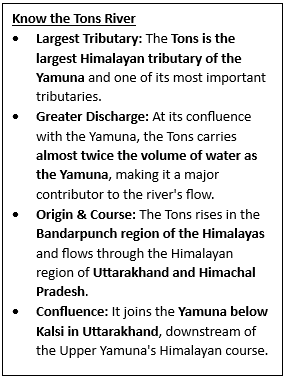
• Location: The project is proposed on the Tons River, along the Himachal Pradesh–Uttarakhand border, covering parts of Sirmaur district in Himachal Pradesh and Dehradun district in Uttarakhand.
• Dam: A 232.6-metre-high concrete gravity dam is proposed.
• Multipurpose nature: The project combines water storage, irrigation, drinking and industrial water supply and hydropower generation.
• Power: It has an installed capacity of 422 MW and is expected to generate around 1,476 million units of clean hydropower annually.
• Irrigation: The project is expected to create irrigation potential over approximately 97,000 hectares.
• Water supply: Benefits are envisaged for Haryana, Delhi, Rajasthan and Uttar Pradesh, while Uttarakhand and Himachal Pradesh also have specified water allocations under the agreement.
Kishau and the Upper Yamuna Water-Sharing Framework
• 1994 Upper Yamuna Agreement: On 12 May 1994, Haryana, Uttar Pradesh, Rajasthan, Himachal Pradesh and Delhi agreed on the allocation of utilisable surface waters of the Upper Yamuna Basin. Uttarakhand subsequently became a party after its creation in 2000.
• Need for storage: The framework recognised the need for storage projects to regulate seasonal flows and improve the reliable utilisation of Upper Yamuna waters.
• Three major projects: Kishau, Lakhwar and Renukaji were envisaged as major storage projects in the Upper Yamuna system.
• Separate project agreements: The 1994 framework envisaged separate agreements for individual storage projects, providing the institutional basis for the present Kishau agreement.
Why Was Kishau Delayed?
• Cost-sharing concerns: States differed over the distribution of project costs and the corresponding benefits, particularly regarding the financial burden on Himachal Pradesh.
• Submergence and displacement: The proposed reservoir involves land submergence and associated rehabilitation concerns in the project area.
• Distribution of benefits: Himachal Pradesh would bear impacts within its territory, while substantial water benefits would accrue to downstream States. The absence of an acceptable cost-benefit arrangement prolonged the deadlock.
• 2026 breakthrough: The Centre and participating States reached consensus on the cost-sharing arrangement in June 2026, including a special mechanism for Himachal Pradesh’s water and power components.
Significance of the Agreement
• Upper Yamuna water security: Regulated storage can strengthen water availability for drinking, irrigation and industrial requirements across the beneficiary regions.
• Yamuna flows and conservation: The project is expected to contribute to more regulated flows in the Yamuna. Union Home Minister Amit Shah linked the agreement to improved water availability and Yamuna conservation, including a stated estimate that 25% of the water would become available through the agreement.
• Irrigation and clean energy: Kishau combines approximately 97,000 hectares of irrigation potential with 422 MW of hydropower capacity, providing both agricultural and renewable-energy benefits.
• Cooperative federalism: The agreement demonstrates how Central assistance and negotiated cost-benefit sharing can help unlock long-pending inter-State water infrastructure.
• Integrated basin development: Together with Lakhwar and Renukaji, Kishau strengthens the storage infrastructure envisaged for the Upper Yamuna Basin.
Khan Global Studies App
With our training programs, learning online can be a very exciting experience. Take the next step toward achieving your professional and personal objectives.



Course Related Query:
Ask Your DoubtsStore Related Query:store@khanglobalstudies.comNEET | JEE | CUET
NCERT Books
Resources
We love learning. Through our innovative solutions, we encourage ourselves, our teams, and our Students to grow. We welcome and look for diverse perspectives and opinions because they enhance our decisions. We strive to understand the big picture and how we contribute to the company’s objectives. We approach challenges with optimism and harness the power of teamwork to accomplish our goals. These aren’t just pretty words to post on the office wall. This is who we are. It’s how we work. And it’s how we approach every interaction with each other and our Students.
Come with an open mind, hungry to learn, and you’ll experience unmatched personal and professional growth, a world of different backgrounds and perspectives, and the freedom to be you—every day. We strive to build and sustain diverse teams and foster a culture of belonging. Creating an inclusive environment where every students feels welcome, appreciated, and heard gives us something to feel (really) good about.